


There's no substitute for real-world experience
Let’s say you have a fantastic idea for a blog post, a creative project, or a business. The grindset mentality teaches that the way to success is to lock yourself in your office, pull all-nighters, do the research and the hard labour, and come out on the other side a winner. More effort equals more reward.
Hard work is important, but all the time you’re grinding away, you’re also making a thousand assumptions about your customers, the market, and life. The same is true outside of entrepreneurialism – consume too much social media and your worldview is based on trending posts. You might not realise the house of cards you’ve built on those shaky foundations until it’s too late.
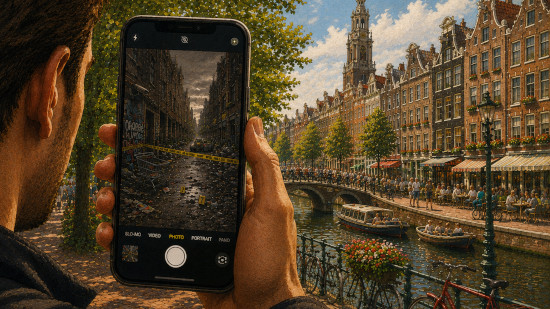
This is also a reason to be careful about reminiscing. No matter how good your memory, you can’t possibly recall every detail from previous scenes in your life. Your brain fills in the blanks, and it’s easy to create an embellished memory of a semi-fictional time or place that no real experience could ever live up to. Trust your inaccurate recollection of the past without question for too long, and the present might seem eternally dull by comparison.
Assumed representation
When people see things through distorted lenses – either the internet, their unreliable memories, or pure imagination – they make flawed assumptions about the world, which has real ramifications for business and society.
I’m of the opinion that many issues in modern politics stem from politicians and analysts who place too much weight on social media. When an MP looks at their X feed, for example, it’s impossible to tell which viewpoints belong to their constituents, the wider public, or foreign actors attempting to influence policy. Even if we assume they only see posts from locals, it’s easy to think the loudest takes are representative of general public opinion, when they’re not – the opposing view could be more popular, just less discussed online.
The human mind is built to live in reality – not online, with its worldview delegated to social media feeds and abstract metrics.
In business, think of the leader who sits in a top-floor office in a big city, but manages a company spanning hundreds of locations around the globe. It’s almost impossible for them not to abstract away the complexity with metrics. But without real information about what’s happening on the ground – which often can’t be so neatly structured – their decisions aim only to adjust the data points in their dashboard, and don’t necessarily fix the real issues.
We can’t live purely online lives, delegating our worldview to social feeds and metrics. We’re not designed for it. The human mind is built to exist in reality, and we can’t accurately make the leap from what we see on screens to what’s out there in the real world. We extrapolate and assume – and that can be dangerous when we take flawed actions based on our generalisations.
Experience over assumptions
It all comes down to this: There is no substitute for real-world experience. You need actual data from the actual world. These will also be isolated data points, but your brain is better at recognising the context – “I spoke to two people and they said X,” rather than: “I saw two posts that said X and they had lots of likes, so millions of people must think the same thing.”
Before I entered the cyber security industry, I completed some top-of-the line courses, which included practical exercises where we’d practice our techniques by running attack and defence against virtual machines in a lab. But when I got a job and encountered my first corporate environment, it looked very different. The network was orders of magnitude more complex, there were device types I’d never seen before, and there were change control processes to contend with. It took years working within large organisations before I was comfortable applying the same concepts in the real world.
I recently learnt that Costco’s current CEO Ron Vachris joined Price Club, one of the companies that merged into the retailer, as a forklift driver in 1982.1 He then worked his way up the ranks, through warehouse management and into corporate leadership. Having worked at all levels of the company, he has an uncommon appreciation for the workers on the ground and a culture that extends beyond headquarters. When nurtured correctly, both of these deliver a better customer experience and contribute to sales of what Vachris calls the most important item Costco sells: its customer membership card. His first-hand experience contributes directly to a healthier business.
Gathering real-world data
A very literal example of leaving your desk and getting out in the real world comes from the making of one of my favourite video games of all time, 2008’s Grand Theft Auto IV. For the unfamiliar, GTA IV takes place in Liberty City, which is a fictional but remarkably atmospheric stand-in for New York City.
During the initial phases of the game’s development, Rockstar flew its team – including actual architects – out to New York City to experience it first-hand, and took around 250,000 photos of the city. It kept a research team out there to handle requests for small details about certain areas, interiors, and traffic patterns. The team even went as far as to review public reports on New York’s population and infrastructure for drainage, sewage, and electricity. “Some of this is obviously superfluous in some respects,” art director Aaron Garbut told IGN ahead of GTA IV’s release, “but it’s important to start everyone thinking about how something works so they can build with that in mind.”
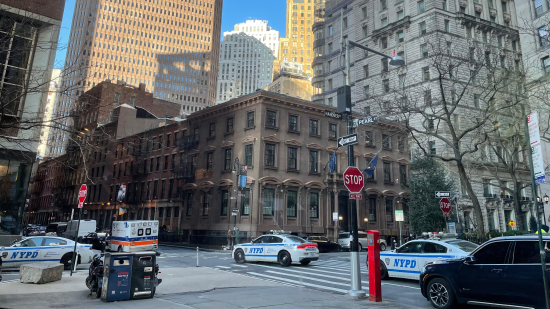
The Rockstar team could have made a perfectly serviceable version of New York from their desks in Edinburgh. They could have searched for photos online, watched TV shows and films, and constructed something fairly close. But they weren’t content with fairly close. Their dedication to gathering real-world data enabled them to build arguably the greatest ever video game city.
You don’t go to those lengths if you’re creating a product with only money in mind. You do that if you’re creating art, and want to do something nobody has ever done before. The same applies for any business or creative project – you could create something good in isolation, but only by getting out there to see what things look like in reality can you craft something groundbreaking.
Beyond your four walls
If you’re about to make an assumption in your work, pause for a moment. Is it an assumption that’s safe to make from a distance? Or is the leap too big? Has your worldview been skewed by sample size, bias, or abstraction? If you truly care about what you do, these are warning signs that you should leave your desk, get out into the real world, and gather first-hand data. Doing so could make the difference that elevates your work to something truly great.
GTA IV doesn’t look as pretty as modern games, but Liberty City’s sense of place still holds up 18 years on. When I finally visited New York in 2024 – and again when I returned the following year – my brain sometimes struggled to comprehend what it was seeing. From the landmarks to the ambience, I was often struck by a surreal feeling that I had stepped into a virtual city I had spent countless hours exploring years ago.2 To me, that’s a testament to the Rockstar team’s dedication to real-world experience and data gathering.
So don’t live solely in theory, abstraction, and rational hypotheses. Back up your assumptions with first-hand empirical evidence. Be the CEO who walks the factory floor to understand how things are really done. Be the artist who spends as much time gathering reference shots as creating their own work. That extra legwork could make all the difference, and reveal things to you that would be obscured by metrics and second-hand information. Because there really is no substitute for your own real-world experience.

Notes and references
-
Credit to The Ben and Emil Show, one of my new favourite podcasts, for bringing to my attention just how interesting a business Costco is. I usually listen for their tech-adjacent episodes, but I enjoyed How Costco Mastered Capitalism far more than I thought I might.
-
The only other place where I’ve felt something similar is Kabukicho in Tokyo. The primary setting for the Yakuza game series (now Like a Dragon) is a dense and meticulous metre-by-metre recreation of a small slice of the city, under the fictional name Kamurocho. It’s so accurate that I found I could navigate the area in real life based on memories of the games, which was an odd feeling.

