


Mixtape is unique, but nowhere near a perfect game
Mixtape has been the subject of a huge online debate since an IGN review scored it ten out of ten. By ranking Beethoven & Dinosaur’s musical teenage tale alongside the gaming greats, it set off a discussion that got down to the foundational question of what a video game actually is – but I don’t think there’s any definition under which Mixtape can be considered perfect.
Escaping the Big Suck
Mixtape follows a group of teenagers planning one last party before they leave their hometown. It’s about three hours long, and is structured around its soundtrack – the titular mixtape compiled by main character and narrator Rockford. Each song frames one of her teenage escapades or memories.
The characters are annoying, as teenagers can be, but are also poorly written at times. Real-life teenagers act impulsively based on emotion and hormones without knowing exactly why. But Mixtape’s cast are unnaturally self-aware and clearly state their intentions – declaring they want to “ride a flaming stallion of delinquency”, or fretting about “the optimal teenage experience”. Those moments ruin any immersion, turning what would be a group of fairly believable teenage slackers into transparent mouthpieces for the writers.
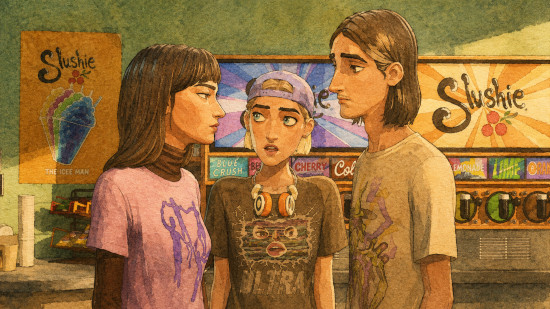
Rockford introduces each song with a High Fidelity-style monologue that attempts to build some sentimentality. The issue is that she rarely goes much further than stating the track’s release year and album. It’s clear somebody has something to say about music and its place in life – other scenes compare a dull life to “elevator music”, for example – but those moments don’t earn any gravity when so much else about the characters is generic or unlikeable.
Reliving the 1990s(?)
While there are some Life is Strange-style walk-and-click areas, Mixtape’s most memorable gameplay segments play as interactive music videos. The soundtrack plays as you engage in linear travel (skateboarding, running) or small mini-games (mixing a slushie, the infamous tongue kissing simulator).
At their best, these are fun in the way a lively scene in a film is fun. Skating down the road with your friends, sunshine beating down and 80s synth pop blaring in your ears, while wondering how long it lasts and what awaits you when you finally leave your hometown – that’s that teenage feeling Mixtape tries to evoke, and it shines through when it drops the pretentiousness.
Uncanny valley
While its strongest points are its flashes of believability, Mixtape doesn’t nail its setting completely. The Big Suck, as the characters call their town, is a melding of 80s and 90s coming-of-age movies, and certain details are a little bit out – for example, Rockford rewinds a cassette tape the wrong way, and the pause menu features a CD-R with a storage capacity that never existed. Still, the vibe holds up, as long as you don’t look too closely.
The music-led sections are often fantastical and visually memorable. One more melancholy moment sees Rockford floating slowly through a scene in black and white. When the teens fume about Cassandra getting grounded by her police officer father ahead of the party, you skate through town to the Smashing Pumpkins, blowing up cars and dustbins by flipping them off.
But as a game, Mixtape has limited merit. Online critics have highlighted how little input these segments require – in most cases, you’ll progress even if you set the controller down. The interactive parts are optional extras – doing skate tricks, setting off explosions, or knocking VHS tapes off shelves – and it’s telling that most of Mixtape’s achievements take a “do X of thing” format.
A perfect game?
Mixtape has prompted reflection on the question: What is a video game? Does the word game apply to an activity with no challenge, and no way to win or lose? It’s arguable that we need a new category for this kind of experience, which is more like a visual novel with some mild interactivity – far less even than Life is Strange, which had choices, branching narratives, and fail states.
Mixtape essentially plays itself, and you’re just along for the ride. Its type of interactivity reminds me of some interactive storybooks my sister and I had when we were kids – we could press the buttons to play sound effects to our own amusement, but it was still a linear story we had no control over.
Even if you meet Mixtape where it is, it's not a perfect product – its story isn't compelling enough, and nobody grows as a person
But even if you put the interactivity debate aside and meet Mixtape where it is, it’s by no means a perfect product. The story isn’t compelling enough to support a narrative-focused experience – it’s predictable and trope-riddled. Nobody grows as a person. When conflict occurs, it’s either quickly forgotten or resolved by one character restating their argument in such an unnatural way for a teenager that you begin to ponder the writing process. By contrast, the best films in the genre see teenagers learn without realising it – we appreciate the lessons as the audience, but they’re living in the emotion.
IGN’s other 10 out of 10 reviews include games that pushed the boundaries in world development, story, and gameplay. They include some of my favourite games ever, like Grand Theft Auto IV and Metal Gear Solid 4 (although I prefer Sons of Liberty). Individual reviewers might rank Mixtape differently based on how they weight gameplay, story, and mood – but even if you focus on its strengths, it’s hard to believe it deserves a score higher than a six or seven. It has its memorable moments, but it’s nowhere close to the all-time greats.

