


F1's new regulations deliver spectacle without soul
How do you enshittify an entire sport? Certain football clubs are having a go, but they can’t match a whole governing body prioritising cash over the sport itself, as FIFA is competently demonstrating ahead of this year’s World Cup. Those extortionate ticket prices and mid-game breaks to allow additional advertising slots are a slippery slope for the once-beautiful game.
Formula 1 fans feared similar deterioration after the series’ 2017 purchase by Liberty Media. Some of the racing since then has been great, but we’ve also seen the new leadership prioritise a new generation of Formula 1 fans with the pseudo-documentary Drive to Survive, the infantilisation of drivers on social media, and a relentless focus on celebrities and influencers attending races, which it seems they prefer to hold on tight streets over classic tracks. Many long-time fans feel they’re chipping away at the sport’s soul.
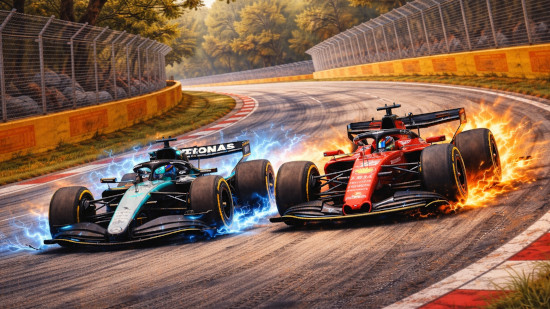
This year, however, the threat comes from the sport’s governing body: the FIA. New regulations for 2026 include a heavier focus on electrical power, active aerodynamic parts, and smaller cars – aimed at better racing, but also shaped by manufacturers who want F1-developed technology to be more useful to their road vehicles. But have they gone too far in the process?
The complaints from drivers started at pre-season testing – if not before – and the quote that seems to have stuck came from Max Verstappen, who dubbed the project “Formula E on steroids”. It wasn’t clear what we could expect as fans going into the new season, but three races later it feels like we’ve seen enough racing to make a fair assessment of the new rules.
Differences of opinion
Of course, an enjoyable driving experience isn't a reliable indicator of how entertaining a generation of cars will be to watch. A driver wants an easy-to-drive and reliable car, but that can lead to predictable races driven purely by strategy and with little spontaneity. Formula 1 has always had to strike a balance between the demands of drivers, manufacturers, and fans seeking on-track drama. But at the same time, it's hard to remember a regulation change that was so universally unpopular.
The reliability lottery
When asked what they miss about classic Formula 1, many fans hark back to the 1980s and 1990s – not just for the racing itself (we’ll get there), but for what felt like more spontaneous and unpredictable motorsport. In recent decades, teams have refined their machinery and drivers have spent more time in simulators than on the track. But in previous eras, car failures were common enough that it wasn’t over until the last lap, even for the leaders.
2026 has seen a revival of sorts for reliability issues. Plagued by problems, Aston Martin’s drivers have managed one finish between them. Red Bull have had their own problems, with Max Verstappen forced to retire in China and Isack Hadjar’s car going up in smoke at Albert Park in perhaps the clearest callback to the engine blow-ups of previous decades. McLaren, meanwhile, left both reigning champion Lando Norris and Oscar Piastri in the pits at the start of the Chinese Grand Prix due to two separate battery issues.
Nobody wants to see drivers sitting in the pit lane, and I’d argue that the non-starters we’ve seen this season detract from the spectacle. But the in-race reliability issues show that there are still technical challenges for the teams. The cars aren’t as dialled-in as they were for the last decade. And it provides an unpredictable wildcard that could instantly spice up any race.
Formula E on steroids
There has been more on-track action in the first two races – especially between front-runners Mercedes and Ferrari, whose drivers have regularly swapped positions back and forth over the early stages. The new cars appear to have overcome the previous generation’s issues with following the car in front, with drivers no longer needing to lag behind for tens of laps waiting for the perfect conditions to strike. They just seem to go for the pass.
It all looks very exciting to the untrained eye, but feels artificial to seasoned viewers because of the role battery boost plays. If the following driver has more charge, then the odds are they’ll overtake – just for the car they passed to do the same thing once the tables turn. It often feels unearned, and it’s also a very opaque mechanic – it wasn’t until Lap 17 in Australia that the broadcast showed a battery graphic with the data needed to make sense of battles, and even then there are rumours that the data shown is estimated because the teams don’t want their deployment strategies made public.
Another consequence of the battery system is “super clipping”, whereby power dips and cars slow at the end of long straights to harvest energy to refill the battery. Nowhere has this been more apparent than at the iconic, flat-out 130R turn in Suzuka. It’s tragic to see cars in the world’s premier motorsport series slowing down – especially on qualifying laps, which have always traditionally shown the cars being pushed to their absolute limits.
Eyes on the road
F1's new focus on battery management also has safety implications. One issue is the distraction of monitoring battery levels – Lando Norris said he was looking at his steering wheel when he ran over debris in qualifying at Albert Park. The other, perhaps more alarming, problem is that because cars deploy battery power at different times, there can be significant speed differentials between drivers on the same piece of track. In Suzuka, Ollie Bearman had to take evasive action as he closed rapidly on the harvesting Alpine of Franco Colapinto into Spoon, and limped away after a heavy impact with the barrier.1
A turning point?
To be clear, I do still believe there are some positives to the 2026 regulations. We’ve dreamed of cars that can follow more closely for at least a decade, and if we had vehicles with more traditional power units then we could all be enjoying a season of on-track battles unhampered by trailing turbulence.
But there’s something wrong with Formula 1 in its current state. After qualifying in Suzuka, drivers said the dynamics of the current cars make it feel like the harder they push, the slower they go. If they take corners as quickly as possible, they sacrifice battery power elsewhere on the lap.
Contrast that with the qualifying laps from past eras that fans share on social media. Formula 1 used to be about pushing to the edge with all available power, to a level where a small miscalculation could make or break a lap. The ultimate test of a driver’s command of his vehicle has now been replaced by a more restrained lap with too much focus on harvesting and deployment.
Formula 1 knows it has a problem – the question is whether it will acknowledge it, and how much can be done to fix it in the short term.
Formula 1 must know it has a problem. There’s too much noise from fans and drivers for the organisers to ignore. It blamed camera issues, but its footage of Kimi Antonelli’s pole lap in Suzuka mysteriously cut to an offboard view just as he approached 130R and the super clipping would have been evident. Fans have also accused the organisation of removing negative comments (though this may just be interference by an overeager AI moderation tool).
The question is whether Formula 1 will acknowledge it has a problem, and even if it does, how much it can do to fix it. The cancelled Middle Eastern races give those in charge some breathing room before the Miami Grand Prix in May. Hopefully it’s a chance to assess what can be done about the issues.
But whatever can be done at this point will only be damage limitation. A Formula 1 engine takes years to develop, and it’s unclear how much can be fixed even for the 2027 season. Hopefully the rules can eventually be refined in a way that rolls back these unpopular changes, but who knows how much damage will be done to Formula 1’s popularity in the meantime – because in its current form, Formula 1 just doesn’t feel like Formula 1.
Notes and references
- Update – Minutes afer I published this post, the FIA issued a statement announcing a review of the regulations in light of Bearman’s crash. It said the rules “include a number of adjustable parameters, particularly in relation to energy management, which allow for optimisation based on real-world data”, that a review was always planned after the first few races, and “a number of meetings” between all involved parties are scheduled in April. We’ll have to wait to see what they come up with.

