


Field Notes 9 // Museums, Facebook, and new Muse
This is Field Notes, my monthly newsletter on technology without the hype. Subscribers get it weeks before it goes up on the blog. Subscribe below.
For all my talk about slowing down in last month’s newsletter, it’s proven difficult to sustain in regular life. While I could afford a couple of hours in bed with a coffee and a book when I was in a Maltese hotel, it’s a lot harder to justify to myself when I know I need to run, work out, work, write articles, cook dinner, clean my home, wash my clothes, and everything else.
I still find some small periods to reflect, and it’s usually when I listen to somebody else describe their experiences – often podcasts or videos about escaping the firehose of information aimed at our brains every day. I also like hearing small, personal stories about things that happened in the real world, and could have done so decades ago, before the internet and smartphones.
They serve as a reminder that there is a concrete world out there, and there always has been. There are narratives that exist beyond the amalgamated global thread that dominates social media – occurrences affecting a small number of people in a tiny area that are just as interesting and impactful as anything concerning the latest political squabble or AI innovations.
I want to get better at seeing them, and spend more time focusing on them.
Ashmolean Museum, Oxford
I’m not the touchy-feely type when it comes to art. Whether I like a piece or not mostly depends on aesthetics, not some deep underlying meaning. But I spotted a plate adorned with an illustration at the Ashmolean Museum in Oxford this month that has regularly returned to mind ever since.
Foolishly, I didn’t take a picture of the artefact’s description, but through a combination of Claude and the museum’s online directory, I tracked it down. According to the records, it’s an 18th Century piece from the Italian town of Castelli, in the Abruzzi region. It’s unclear whether fields and peaks on the plate depict the same area, but a Google Images search suggests it’s likely.
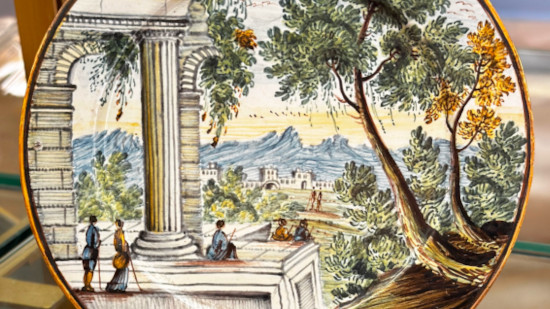
I think it’s memorable to me for the reasons I discussed in the intro. The people in the picture are all in relaxed poses, angled towards the hills in the distance, as though they’re taking in the landscape. It suggests a slow pace. While I must do constant battle with a black rectangle in my pocket that always threatens to distract me, these people had no choice but to focus on the present moment and their immediate surroundings. Life was simple.
I know I’m veering dangerously close to “quit your tech job and become a farmer” territory here. I’m not saying I will (or want to) do something so drastic. I enjoy technology – and even online discussions, much of the time. But it’s nice to have the occasional reminder that while I spend so much of my day looking at one screen or another, none of that is real life.
Careless People
My reading for this month was Careless People by Sarah Wynn-Williams, Facebook’s ex-director of public policy. It’s an eye-opening book, and paints a damning portrait of the social media company and its leaders.
Much of the coverage of the book’s 2025 publication focused on anecdotes that show senior figures like Mark Zuckerberg and Sheryl Sandberg behaving in ways that are arrogant, cruel, and sometimes just plain odd. But beneath all that is a story of Facebook as a once-idealistic organisation that wanted to connect the world descending into a business chasing growth at all costs.
At one point, when faced with a decision over whether to pay a fair share of tax, the leadership opts instead to get closer to electoral campaigns so that politicians feel indebted to the platform and implement friendly policies. This kind of approach immediately brought to mind Big Tobacco’s tactics, and amusingly the comparison also came up in a board meeting:
“The board gets into a conversation about what other companies or industries have navigated similar challenges, where they have to change a narrative that says that they’re a danger to society, extracting large profits, pushing all the negative externalities onto society and not giving back. People suggest various analogues that don’t seem to fit very well and then Elliot finally says out loud the one I think everyone’s already thinking about (but not saying): tobacco. That shuts down the conversation and they move on to the next agenda item.”
Careless People made for interesting reading, especially at a time when Meta was among several companies that just lost a lawsuit on the grounds that they purposefully built platforms designed to be addictive for users.
There are also some alarming passages about how Facebook cosied up to China, giving it access to personal data in exchange for access to the country – again, growth at all costs. But what was just as shocking to me was the way that – at least until the very end – Facebook largely managed to keep its employees on-side, convincing them that they were a force for good.
“Most people seem to take it seriously. Both the idea of the Facebook Family and Facebook’s mission. Maybe because we’re mostly in our twenties and early thirties, we’re particularly susceptible to the moral and social messages that leadership is indoctrinating us with. Or at least I am. I buy it. Working at Facebook isn’t a job; it’s your life.”
It links back to something I’ve been thinking about a lot: incongruence between grand narratives and the actions people take in the real world. I’ve written before about how abstract management revolving around metrics can lose sight of details in pursuit of numbers. By Wynn-Williams’ account, Facebook’s leaders fell into a similar trap, allowing themselves to be blinded to wider issues by tunnel vision focused on personal obsessions.
Be With You by Muse
A couple of weeks ago we got a new song from my favourite band. Musically, it’s certainly not Muse’s best work. There’s a synthy verse in the middle that reminds me of the worst type of poppy, radio-friendly Muse. But I like the organ intro and that one unexpected chord change in the verse progression, and I like when the guitar solo bursts through the noise towards the end.
What’s more notable is the feeling behind the song. Matt Bellamy sings it like he means it. It has an authentic energy. I’m resigned to the reality that we’re past the heights of Muse’s “big three” albums, which were packed with angst and unpredictable twists, but between Be With You and Unravelling, I’m hopeful that The Wow! Signal might be their best album since Drones.
Maybe I was one-shotted by the teaser imagery, but something about the mood reminds me of hot summer nights when I was young, when I’d leave my blinds open and lay on my bed watching the light fade in the sky, at once both completely relaxed and excited for the future. Incidentally, that was the age when I was most into Muse, so it adds to the song’s personal connection.
Shortly after Be With You’s release, Muse announced a tiny show at Brixton Academy in London, which I was lucky enough to get a ticket to and will be attending over the Easter bank holiday. Given the size of the gig and that 2026 marks 20 years since the release of Black Holes and Revelations, I’m hoping for a memorable evening and performances of some rare songs. I’ll almost certainly let everyone know how it was in next month’s newsletter.
Things that left an impression
-
Game programmer Lars Thießen posted an excellent article diving into the internals of RollerCoaster Tycoon. It’s often stated that Chris Sawyer wrote the theme park management game in Assembly, but we rarely get more detail. Here, Thießen covers specifics around its optimisation, including the fascinating ways efficient code interacts with gameplay elements like guest pathfinding and crowd control.
-
Craig Mod popped up with a rare essay describing his experience with Claude Code as he attempted to vibe code software capable of handling his unique tax situation in Japan. It’s refreshing to read a take from somebody excited about using AI, but not completely convinced it’ll revolutionise software and put all developers out of work. Instead, Mod focuses on what I think AI is best at: building simple, bespoke utilities with a target audience of one.
-
The Atlantic caused a stir online with a long-form article where it gave McKay Coppins $10,000 and let him loose on sports gambling websites. The end result is predictable, but what makes the piece so gripping is the author’s meticulous first-hand account of how his casual betting turned into something darker and more compulsive.
That’s all for now - subscribe below to get next month’s newsletter first!

