


AI could commodify thinking and destroy deep work
Anthropic recently launched Claude Cowork in preview, and it looks to be the most directly useful implementation of AI yet outside of coding. By giving Claude access to a folder on your computer, you can have it organise files, summarise notes, or create a report from a set of expense receipts.
Reviews are generally good: Wired marvelled that Cowork “actually works”, and ZDNet called it “brilliant and scary”. The general vibe seems to be that such a practical application of AI could threaten white-collar jobs.
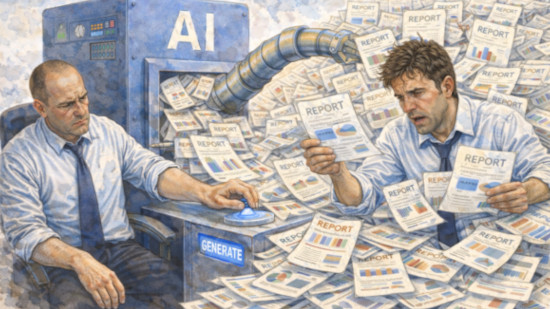
But while everyone debates job losses, few are asking what happens to the workers who remain. Tools like Cowork could all but eliminate the doing aspect of office work, and while that might sound like huge efficiency, it risks pushing jobs to a pace incompatible with human thinking and eliminating the value of the process itself – for workers, employers, and customers alike.
The context switching trap
First, think about the minute-to-minute experience with a tool like Claude Cowork. You point it at notes from a series of meetings and they’re quickly compiled into a report for your review. You’re about to pitch a new idea, and Cowork automatically builds a deck from your wireframes. You need to find some information in a company policy and it’s instantly pulled for you.
Humans have a well-documented mental limit when it comes to context switching. Cal Newport’s Deep Work research shows we operate best with sustained focus. Yet with AI agents handling tasks that previously required said focus, we could spend our days jumping between prompts and reviews – never settling into deep work or using our full mental capacity at all.
We’ve already struggled with the transition to a digital economy – emails popping in on your phone, Slack notifications interrupting your train of thought, and so on. But if AI reduces most work to a few minutes’ wait, we’ll spend entire days flitting between quick, surface-level tasks. The cognitive cost compounds: you can’t think deeply about a strategic problem when you’re also reviewing three AI-generated reports, approving two deck designs, and fact-checking a policy summary, all within an hour.
From craft to commodity
Consider Sky Sports’ odd recent experiment. Fans were locked in “The Box” on Manchester derby day, with the result revealed at full time. The outcome was the same, but the joy and emotion of the journey was lost. AI does the same thing to knowledge work, relegating thought to an assembly line. The satisfaction of craftsmanship – and what you learn along the way – is lost. The only consideration is whether the end product is “good enough”.
Companies want to save money with AI, and people want to expend less effort – but we don't ask what gets lost in the process
I often see this in writing. As a former journalist, I place huge value on clarity and concision. It pains me to read AI-generated content, which has neither. The difference is easy to spot, but people keep churning it out because they only care that there are words on the page. They don’t consider the quality. It’s the productivity equivalent of the cookie-cutter flats that are often built in the UK – cheap, acceptable to look at, but utterly soulless.
Using AI to generate content (words, video, music, and so on) is rarely useful outside of memes and bland corporate productions, but we default to it when we forget the craft of what we do. Companies want to save money, and people want to expend less effort. If AI promises the same kind of output faster and cheaper, we don’t ask what gets lost in the process. We just see savings.
The taste advantage
I think that taste will become the key differentiator in years to come. There’s already growing resistance to AI slop, but the technology still maintains much of its novelty – for now, at least. In future, more people will tire of its sterile output and seek products that show genuine craft and originality.
Those who actually do things – who sit at a desk, perhaps even with a pencil and paper, and lock in – are the ones who will retain the focus and control required to reach that mastery. When writing and design are predominantly AI-generated, they’ll be the ones who cut through the noise and get noticed. Analogue creation and traditional craft will be a competitive advantage.
Is there a place for AI in that sort of workflow? Yes. Think back to Claude’s marketing last year – the New York City café pop-up, with the emphasis on AI as an augmentation to human thinking, rather than a replacement. That’s the key: to use AI as a tool, not a stand-in. Protect deep work time. Choose slow, deliberate thinking over instant AI output. Let AI handle true assembly line tasks – formatting, data processing – but keep the thinking for yourself.
AI is a probability machine that can’t think for itself – if you hand it control of your professional and creative projects, it stops you from thinking, too.

