


How to opt out of X's engagement-first algorithm
Although I follow him, it’s usually bad news when X head of product Nikita Bier appears in my feed. While he provides some useful insight into what happens behind the scenes at the social media giant, his high-performing posts are often defences of unpopular changes to the platform.
This time, it’s the algorithm (again). Bier says it was “rebuilt from scratch by the xAI team”, and now runs out of the company’s Colossus data centre. He also reported that the time users spend on the app is up 20 percent – but the experience of a long-time user on the ground has degraded significantly. Enshittification has long taught us that engagement does not equal value.

X used to do relatively well at curating interesting and valuable posts from people involved in my areas of interest, but my For You feed went completely off the rails when the 2026 update went live. A much higher proportion of posts were videos, and most of those videos covered US political squabbles, public freakouts and fights, and other shocking footage. It was like X had thrown my personal preferences out the window and pushed a new, TikTok-style feed that returned the most viral content on the platform overall.
Screen clutter
Text density is usually a good measure of how useful an app or website will be for me, and one less-discussed change is that X appears to have removed the setting that allowed users to hide images and videos from their feed. That means that as well as seeing lower-quality content, I can also often only see two posts at a time when scrolling because media takes up most of the screen now it is no longer condensed to a link.
The incentives are misaligned. X wants maximum engagement – more scrolling means more ad views, after all. You want to see interesting and insightful posts. These goals are fundamentally incompatible.
Given the widespread complaints, X may well walk some of these changes back – the worst of the wave of slop does already seem to have passed, at least based on my own experience. But the sudden deluge of low-quality content confirmed what we already knew: You can’t trust the algorithm. As long as the tools are available, you need to take control of your feed.
Building your inner circle
The easiest, purest way to make social media more effective is to construct a walled garden to effectively transport yourself back to the 2000s, when social feeds were simple chronological lists of posts by people you followed.
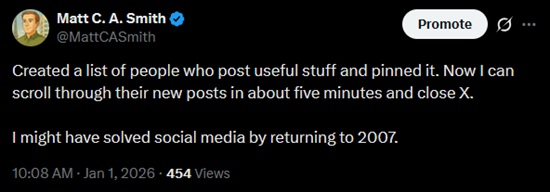
On X, I do this by adding accounts I can trust to provide value to a list, which I then pin to my Home screen. This is the feed I check when I open the app. Because it’s a relatively small list, it doesn’t take much scrolling to hit a post I’ve already seen, at which time I can decide whether I want to venture into the Wild West of the For You feed or close X and do something else.
The advantage of this approach is that it restores control. I get a quick shot of high-quality content, mostly free of political squabbles and videos edited to stoke outrage, and then I reach a natural break point and log off.
The downside is that it hampers discovery. The only new accounts I see are those retweeted by people I already follow. If I stick to the list feed, I’ll find fewer new people to follow, and am at greater risk of confining myself to an echo chamber of similar opinions without any dissenting views.
Algorithms promised personalisation – a tailored feed – but turned into tools in identifying mass appeal and maximising engagement
Venturing outside the wall
Sometimes it’s necessary to step into the unknown and visit the For You feed for discovery, and to keep track of the wider world. This exposes you to the hooks of popular content and infinite scrolling – but when it’s unavoidable you can minimise the damage by taking steps to influence what’s shown.
Firstly, don’t forget to follow people you enjoy – your follows will help to signal your interests to the algorithm. But just as important is flagging what you don’t like with the Not Interested button. For serial offenders, remove them from your feed entirely by muting them (unlike blocking, it’s silent).

Lastly, if you really want to put the effort in, it’s worth reviewing the list of topics that X thinks you’re interested in (Settings and Privacy > Privacy and Safety > Content You See > Interests). You’ll usually find that just about anything you’ve ever interacted with is listed, and cleaning up the list can have a big impact on the posts that make it to your For You feed.
Take it or leave it
Is all this effort worth it? That depends on what you need from X. If it’s critical for your work or interests, the list-centric approach gives you the signal without the noise. If it’s just habitual scrolling, you’re probably better off quitting entirely. But if you do stick around, give the list approach a try.
Unfortunately, this is the reality of modern social media. Algorithms promised personalisation – a stream of content tailored to the individual – but instead they just became tools in identifying mass appeal to maximise engagement. The platform owners’ objectives don’t match your own.
But you might discover you don’t need the algorithm at all – and that’s exactly what X and the other platforms don’t want you to realise.

